IPO in Nepal for Nepalese living abroad: Many Nepalese living abroad hear about IPOs in Nepal from friends, family, social media, or WhatsApp groups. Some people say, “IPO भर्नु राम्रो हो,” while others say, “मलाई IPO बारे केही थाहा छैन, कहाँबाट सुरु गर्ने?”
If you are living outside Nepal and want to understand IPO in a simple way, this guide is for you.
This article explains what an IPO is, why Nepalese abroad should understand it, what documents and accounts are needed, how IPO applications work in Nepal, and how Nepalese Sewa can help you become IPO-ready.
What Is an IPO?
IPO stands for Initial Public Offering.
In simple words, when a company offers its shares to the public for the first time, it is called an IPO.
Before IPO, the company may be owned by promoters, founders, or a small group of investors. When the company issues an IPO, ordinary people also get a chance to apply for its shares.
If you apply for an IPO and shares are allotted to you, you become a small shareholder of that company.
For example, if a hydropower company, insurance company, bank, microfinance company, or other approved company opens an IPO, eligible investors can apply for its shares through the official process.
What Does It Mean to Buy Shares?
Buying shares means buying a small ownership portion of a company.
If you get shares of a company through an IPO, you become a shareholder. As a shareholder, your investment value may increase or decrease depending on the company’s performance, market demand, and overall share market situation.
For beginners, IPO is often seen as the first step into Nepal’s share market because it is usually easier to understand than buying and selling shares in the secondary market.
However, it is important to understand that IPO is still an investment, and every investment should be made with proper knowledge.
Why Should Nepalese Living Abroad Understand IPO?
Nepalese living abroad work hard, earn money, send remittance, support family, and manage many responsibilities. But earning alone is not enough. Financial awareness is equally important.
Understanding IPO can help Nepalese abroad in several ways:
It introduces you to Nepal’s capital market.
It helps you build an investment habit.
It encourages you to keep your financial records and bank accounts organized.
It gives you a chance to participate in Nepal’s growing companies.
It helps you think beyond only earning and spending.
Many Nepalese abroad send money home every month, but without a proper financial system, the money may be spent quickly. IPO, SIP, Demat, MeroShare, Remittance Account, and saving discipline can become part of long-term financial planning.
Foreign Employment IPO Quota in Nepal
Nepal has a provision where a certain portion of IPO shares may be reserved for Nepalese who are in foreign employment and meet the required criteria.
This is one of the reasons why many Nepalese living abroad are becoming interested in IPO. However, to apply under the foreign employment category, you must be properly ready with the required accounts, documentation, and process.
Many people hear about this opportunity only after an IPO opens. By that time, they may not have a Demat Account, MeroShare, CRN, or Remittance Account ready. As a result, they miss the opportunity.
That is why IPO readiness should be done before the IPO opens, not at the last moment.
What Do You Need to Apply for IPO in Nepal?
To apply for IPO in Nepal, you generally need the following:
1. Bank Account
You need a bank account in Nepal. For Nepalese living abroad, a Remittance Account may be important, especially if you want to apply under the foreign employment category.
The bank account is used to block the application amount when you apply for an IPO.
2. Demat Account
A Demat Account is where your shares are stored electronically.
In the past, shares were issued in paper certificate form. Now, shares are kept digitally in a Demat Account.
If you receive IPO shares, those shares are credited to your Demat Account.
3. MeroShare Account
MeroShare is an online platform used to apply for IPO and manage share-related services.
Through MeroShare, you can:
Apply for IPO
View your Demat holdings
Check application status
Apply for right shares or other public issues where applicable
Access share-related online services
For Nepalese living abroad, MeroShare is very useful because it allows you to apply online without physically visiting Nepal every time.
4. CRN Number
CRN means C-ASBA Registration Number.
This number links your bank account with your Demat Account for IPO application purposes.
When you apply for an IPO, the required amount is blocked in your bank account through the C-ASBA system. If shares are allotted, the required amount is deducted. If shares are not allotted, the blocked amount is released back to your account.
Without a valid CRN, you may not be able to apply for IPO through MeroShare.
5. Active Mobile Banking or Online Access
If you live abroad, it is important to keep your mobile banking, online banking, email, and contact details updated.
Many people face problems because their OTP goes to a Nepal number they no longer use, or their bank account is inactive, or they cannot access their MeroShare login.
Before applying for IPO, make sure your access is active and working.
How Does IPO Application Work?
The IPO application process in Nepal usually works like this:
First, a company opens IPO for public application.
Then eligible investors apply through MeroShare or other approved channels.
While applying, the applicant selects the IPO, enters the number of shares, confirms bank details, enters CRN, and submits the application.
The application amount is blocked in the applicant’s bank account.
After the IPO closes, allotment is done.
If shares are allotted, the required amount is deducted and shares are credited to the Demat Account.
If shares are not allotted, the blocked amount is released back to the bank account.
For beginners, this process may sound confusing at first. But once Demat, MeroShare, CRN, and bank account are ready, applying for IPO becomes much easier.
Does Applying for IPO Guarantee Shares?
No.
Applying for IPO does not guarantee that you will receive shares.
In many IPOs, the number of applicants is higher than the available shares. In such cases, allotment may be done through a system-based process, and not everyone may receive shares.
If IPO is not allotted to you, your blocked money is released back to your bank account.
This is why beginners should understand the process clearly before applying.
Is IPO Guaranteed Profit?
IPO should not be treated as guaranteed profit.
Many people think that IPO always gives profit, but every investment has risk. The value of shares may go up or down after listing. A company’s performance, market condition, investor demand, sector, financial health, and overall economy can affect share value.
IPO can be a good starting point for financial awareness, but it should be approached with understanding, patience, and proper planning.
Do not apply for IPO only because someone else told you to. Understand the company, the process, your own financial situation, and your risk level.
Why Nepalese Abroad Miss IPO Opportunities
Many Nepalese living abroad miss IPO opportunities because they are not ready on time.
Common reasons include:
Demat Account not opened
MeroShare not activated
CRN number not received
Bank account not suitable
Remittance Account not opened
Mobile number or OTP access problem
Documents not updated
No idea about IPO opening dates
Confusion about foreign employment quota
Family members in Nepal not able to support the process properly
IPO readiness is not something to do after an IPO opens. It should be prepared in advance.
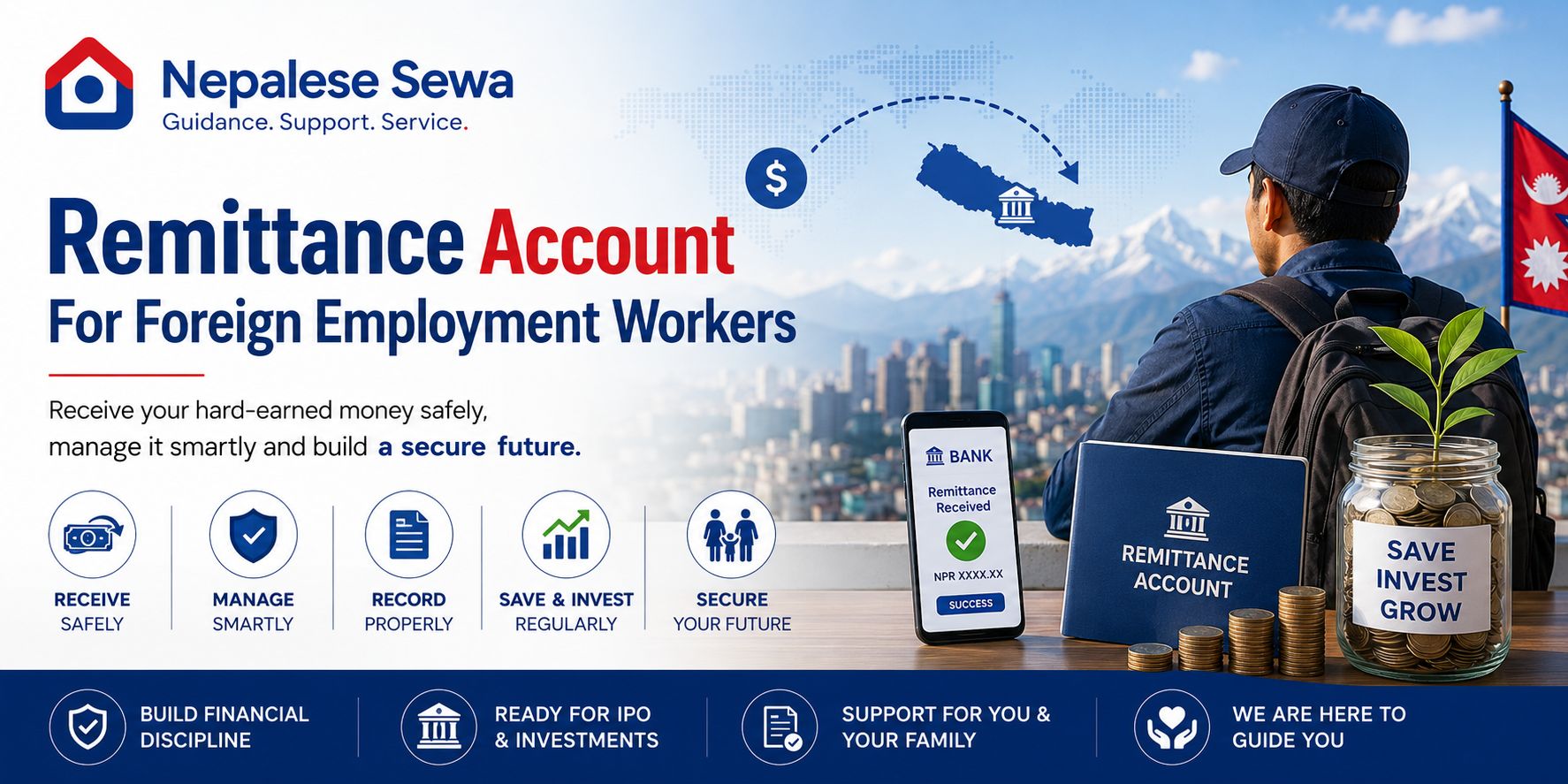
Why Remittance Account Matters for Nepalese Abroad
For Nepalese living abroad, a Remittance Account may be important because it can help show that you are sending money through formal banking channels.
A Remittance Account may also be required when applying under the foreign employment IPO category, depending on the bank and applicable process.
This is why many Nepalese abroad should not open a bank account randomly. The account should match the purpose.
If your purpose is IPO, SIP, Demat, MeroShare, remittance, and long-term financial planning, you should choose the account carefully.
IPO vs Secondary Share Market
IPO and secondary market trading are different.
IPO means applying for shares when a company offers them to the public for the first time.
Secondary market means buying and selling listed shares after they are already listed on the stock exchange.
For beginners, IPO is usually easier to start with because you apply at the issue price and wait for allotment. Secondary market trading requires more knowledge, market understanding, timing, risk management, and analysis.
If you are a beginner living abroad, it is better to first understand IPO, Demat, MeroShare, CRN, and basic financial discipline before entering active share trading.
IPO and Financial Discipline
IPO should not be seen only as a quick profit opportunity.
For Nepalese abroad, IPO can be part of a bigger financial discipline system.
That system may include:
Saving a fixed amount every month
Sending money through proper banking channels
Keeping records of income and remittance
Opening a suitable bank account
Preparing Demat and MeroShare
Understanding IPO and SIP
Building an emergency fund
Planning for future goals in Nepal
When you build a system, your foreign income becomes more meaningful. It does not only go into daily expenses. It starts supporting your future.
Common Mistakes Beginners Make in IPO
Many beginners make simple but costly mistakes.
Some common mistakes are:
Applying without understanding the company
Using wrong bank details
Forgetting MeroShare password
Not renewing Demat or MeroShare on time
Waiting until the last day to apply
Not having enough balance in the bank account
Not understanding foreign employment quota requirements
Believing every social media post blindly
Thinking IPO means guaranteed profit
Avoid these mistakes by preparing early and taking guidance from reliable sources.
IPO Readiness Checklist for Nepalese Abroad
Before applying for IPO, check whether you have the following ready:
Valid Nepali citizenship or required identification documents
Bank account in Nepal
Remittance Account if required for your purpose
Demat Account
MeroShare login
CRN number
Active mobile banking or online banking
Updated mobile number and email
Sufficient bank balance
Basic understanding of IPO process
Awareness of investment risk
If these things are ready, you are in a much better position to apply when IPO opens.
How Nepalese Sewa Can Help
Nepalese Sewa supports Nepalese in Nepal and abroad with guidance, documentation support, and financial readiness-related services.
For IPO readiness, Nepalese Sewa can help you understand and prepare for:
Bank Account support
Remittance Account guidance
Demat Account support
MeroShare support
CRN guidance
IPO readiness process
SIP awareness
Basic financial direction
Our goal is not to make unrealistic promises. Our goal is to provide clear guidance, proper process support, and practical information so that Nepalese abroad can make better financial decisions.
Important Disclaimer
Nepalese Sewa does not guarantee IPO allotment, profit, or investment return.
IPO allotment depends on the official allotment process. Investment value may increase or decrease depending on market conditions. Any investment decision should be made after understanding the risk and your own financial situation.
This article is for educational and awareness purposes only.
Final Thoughts
If you are living abroad, your hard-earned income should not only be used for expenses. It should also help you build a better future.
IPO can be one of the first steps in understanding investment in Nepal. But before applying, you need the right setup: bank account, Demat, MeroShare, CRN, and proper guidance.
Do not wait until an IPO opens. Prepare early.
If you are confused about where to start, Nepalese Sewa is here to guide you.
Nepalese Sewa
Guidance • Support • Service