Foreign employment is one of the biggest financial responsibilities for many Nepalese families. Thousands of Nepalese go abroad to work, earn, support family, repay loans, build a house, educate children, and secure a better future.
But earning abroad is only one part of the journey.
The bigger question is:
Is the money being sent home through the right system?
Is there a clear record of the income?
Is the money being saved, invested, and used for future planning?
This is where a Remittance Account becomes very important.
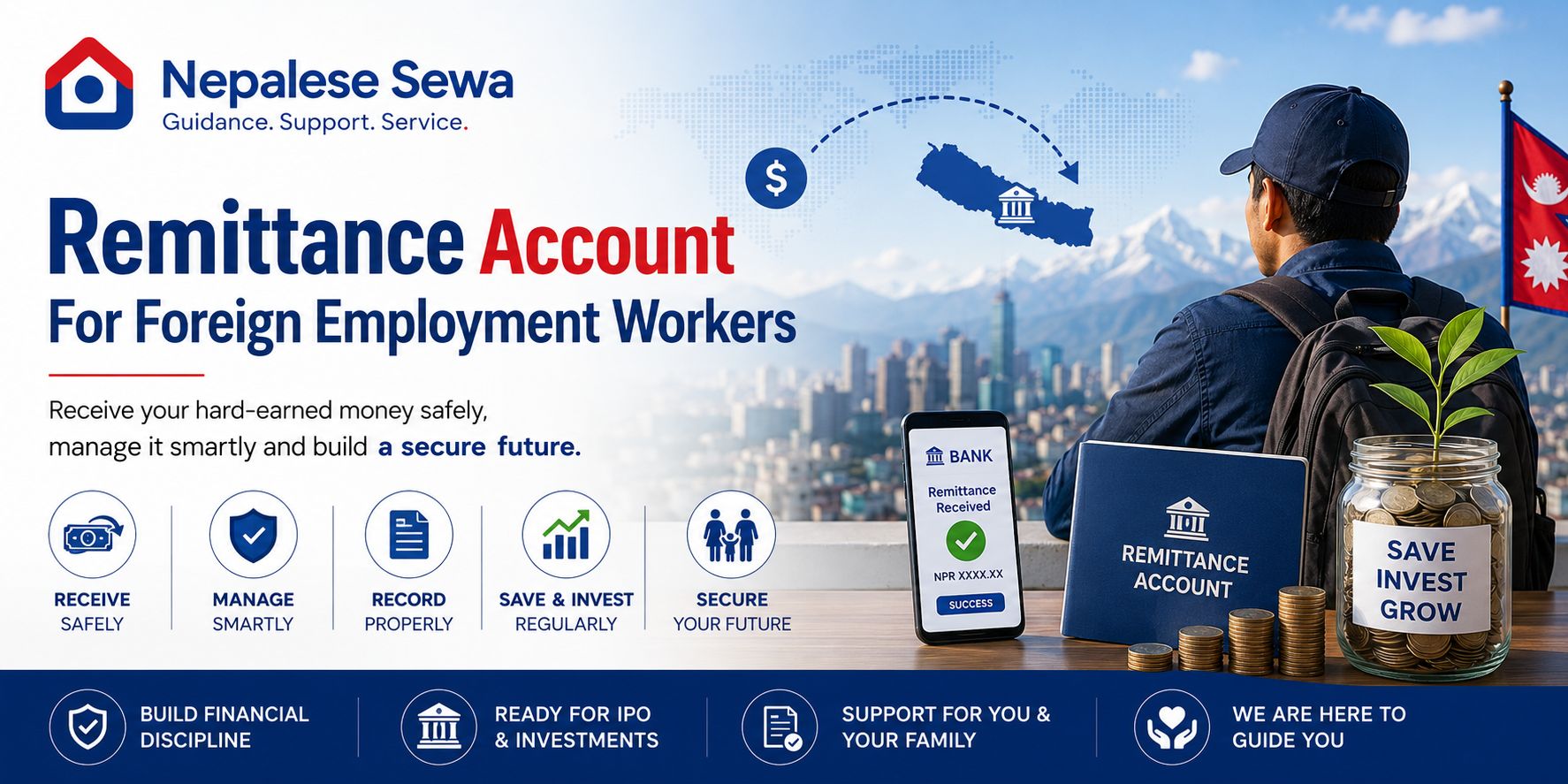
For foreign employment workers, a Remittance Account is not just a normal bank account. It can become the foundation for financial discipline, formal income record, IPO readiness, SIP planning, saving habit, and long-term financial security.
What Is a Remittance Account?
A Remittance Account is a bank account designed for people who are earning abroad and sending money to Nepal through formal banking channels.
In simple words, if you are working abroad and sending your income to Nepal, a Remittance Account helps you receive, record, and manage that money properly.
Many banks in Nepal offer remittance-related savings accounts or foreign employment savings accounts for Nepalese working abroad and their family members. The main purpose of such accounts is to encourage remittance through official banking channels and help workers manage their hard-earned income in a more organized way.
वैदेशिक रोजगारीमा जाने धेरै नेपालीहरूको मुख्य उद्देश्य आफ्नो परिवारको भविष्य सुरक्षित बनाउनु हो। तर विदेशमा दुःख गरेर कमाएको पैसा सही तरिकाले व्यवस्थापन नगर्दा त्यो पैसा खर्चमै सकिन्छ र दीर्घकालीन बचत तथा लगानी बन्न सक्दैन। त्यसैले Remittance Account अर्थात् वैदेशिक रोजगारीमा रहेका नेपालीहरूका लागि बनाइएको रेमिट्यान्स खाताको महत्व धेरै ठूलो छ। यस्तो खातामार्फत विदेशबाट पठाएको रकम सुरक्षित रूपमा नेपालमा जम्मा गर्न सकिन्छ, परिवारले आवश्यक खर्च गर्न सजिलो हुन्छ, र बाँकी रकमलाई बचत, IPO, SIP, Demat, MeroShare जस्ता लगानीका माध्यममा जोड्न सकिन्छ।
पैसा कमाउनु मात्र पर्याप्त छैन; कमाएको पैसालाई सही ठाउँमा राख्नु, रेकर्ड राख्नु, नियमित बचत गर्नु र भविष्यका लागि लगानी गर्ने बानी बसाल्नु अझ महत्वपूर्ण छ। वैदेशिक रोजगारीमा रहेका श्रमिकहरूले रेमिट्यान्स खातालाई केवल पैसा पठाउने माध्यमको रूपमा मात्र होइन, आफ्नो आर्थिक अनुशासन, परिवारको सुरक्षा र भविष्य निर्माणको आधारको रूपमा बुझ्न आवश्यक छ। सही बैंक खाता, नियमित बचत योजना, IPO readiness र SIP जस्ता साना तर प्रभावकारी कदमहरूले आजको मेहनतलाई भोलिको सुरक्षित भविष्यमा बदल्न सक्छन्।
Why Is a Remittance Account Important?
Many foreign employment workers send money home regularly. But if the money is sent casually, received in someone else’s account, used without tracking, or spent without planning, it becomes difficult to know where the income actually went.
A Remittance Account helps create a proper financial record.
It shows that your income came from foreign employment. It helps you keep your money in the banking system. It can support future financial planning and may also be useful for IPO applications under the foreign employment category, depending on the current rules and bank requirements.
For a foreign employment worker, this account is not only about receiving money. It is about building a financial system.
Foreign Employment Income Needs a System
Foreign employment income is not easy money.
It comes from long working hours, physical effort, mental pressure, homesickness, separation from family, and years of sacrifice.
That money should not disappear without direction.
Many workers follow this cycle:
Salary comes.
Money is sent home.
Family expenses are paid.
Loans are paid.
Festivals and emergencies come.
The month ends.
Again, the worker waits for the next salary.
This cycle may continue for years.
If there is no saving system, no record, no investment direction, and no future planning, the worker may return home with very little financial security.
A Remittance Account can help bring structure to this cycle.
Remittance Account and Formal Money Transfer
One of the most important reasons to use a Remittance Account is to keep your money transfer formal and traceable.
When you send money through proper banking or remittance channels, your transaction is recorded. This record can be useful later for financial proof, family planning, investment, bank-related work, and personal financial tracking.
Informal transfer may look easy in the short term, but it may not give you the proper financial record you need in the future.
Foreign employment workers should think long-term.
The goal is not only to send money.
The goal is to send money safely, properly, and with a clear record.
Remittance Account and IPO for Foreign Employment Workers
One of the biggest reasons many Nepalese abroad are becoming interested in Remittance Accounts is IPO.
Nepal has a provision where a certain portion of IPO shares may be reserved for eligible Nepalese working abroad. To apply under the foreign employment category, workers generally need to meet specific requirements such as valid foreign employment documentation, Demat Account, MeroShare, CRN, and a bank account suitable for the foreign employment IPO process.
In many cases, a normal savings account may not be enough for the foreign employment IPO category. A Remittance Account or foreign employment-related account may be required by the bank or system.
That is why workers should not wait until an IPO opens.
IPO readiness should be done early.
If you want to understand IPO from the beginner level, read our detailed guide: IPO in Nepal for Nepalese Living Abroad.
In that article, we explain IPO, Demat Account, MeroShare, CRN Number, Bank Account, Remittance Account, and the basic process of applying for IPO in Nepal.
Remittance Account, Demat, MeroShare and CRN
A Remittance Account becomes more useful when it is connected with other financial tools.
For IPO and capital market readiness, you generally need:
Bank Account
Demat Account
MeroShare Account
CRN Number
Valid documentation
Active mobile or online banking access
Your bank account is used for blocking money when you apply for IPO through the C-ASBA system. Your Demat Account is where shares are stored if IPO is allotted. MeroShare is the online platform through which you can apply for IPO and manage share-related services. CRN links your bank account with the IPO application system.
For foreign employment workers, having these things ready in advance is very important.
Many people miss opportunities because they start the process only after hearing that an IPO has opened.
By that time, they may not have the correct account, CRN, Demat, MeroShare, or updated documents.
Remittance Account and SIP Planning
A Remittance Account is not only useful for IPO. It can also support saving and investment discipline.
Many foreign employment workers want to save or invest but do not know where to start. Some wait for a big amount before starting. Others say, “I will save what is left after expenses.”
But in real life, expenses rarely end.
This is where SIP can be helpful.
SIP means Systematic Investment Plan. It allows you to invest a small amount regularly over time instead of investing a large amount at once.
If your remittance income is coming into a proper account, it becomes easier to plan monthly saving, emergency fund, SIP, and other financial goals.
If you want to understand SIP in detail, read our article: What Is SIP and Why Is It Important for Foreign Employment Workers?
In that article, we explain how SIP helps build financial discipline, why it is useful for foreign employment workers, and why it should be seen as a long-term saving and investment habit, not a guaranteed profit system.
Why Family Members Should Understand the Remittance Account
Many foreign employment workers send money to family members in Nepal.
But if the family does not understand financial planning, the money may be spent without long-term benefit.
That is why the family should also understand the importance of a Remittance Account.
Family members should know:
Why money should come through official banking channels
Why every remittance should not be fully spent
Why saving should be planned every month
Why financial records matter
Why investment readiness is important
Why emergency fund is necessary
Foreign employment should not be only one person’s sacrifice.
It should become the family’s financial planning system.
Benefits of a Remittance Account for Foreign Employment Workers
A Remittance Account can help foreign employment workers in many practical ways.
1. Clear Income Record
It helps maintain a record of money sent from abroad. This record may be useful for future financial planning, bank work, investment preparation, and income tracking.
2. Formal Banking Channel
It encourages money to come through official remittance and banking channels instead of informal methods.
3. IPO Readiness
For eligible workers, a Remittance Account may be important for applying under the foreign employment IPO category, depending on bank and regulatory requirements.
4. Better Saving Discipline
When money comes into a proper account, it becomes easier to divide income into family expenses, saving, emergency fund, SIP, IPO, and future planning.
5. Family Financial Management
It helps families in Nepal understand that remittance should not only be used for spending, but also for building financial stability.
6. Future Planning
A proper account record can support long-term goals such as investment, home planning, education planning, business planning, or return-to-Nepal planning.
Common Mistakes Foreign Employment Workers Make
Many workers make simple mistakes that affect their future financial planning.
Some common mistakes are:
Sending money through informal channels
Receiving salary or remittance in random accounts
Not keeping transaction records
Not opening a suitable bank account
Not preparing Demat, MeroShare, and CRN on time
Using all remittance only for household expenses
Not creating emergency fund
Not starting SIP or investment discipline
Not involving family in financial planning
Waiting until the last moment for IPO or documentation work
These mistakes can be avoided with early awareness and proper guidance.
Remittance Account vs Normal Savings Account
A normal savings account is a general bank account.
A Remittance Account is designed for people receiving income from abroad or for foreign employment-related purposes.
For Nepalese living abroad, a Remittance Account may be more suitable if the purpose is to maintain foreign income record, prepare for foreign employment IPO quota, receive remittance properly, and build a financial system.
However, requirements may vary from bank to bank.
Before opening or converting an account, it is important to understand your purpose.
Are you opening the account only for saving?
Is it for remittance?
Is it for IPO?
Is it for SIP?
Is it for family use?
Is it for long-term financial planning?
The right account depends on your need.
What Documents May Be Needed?
The required documents may vary depending on the bank and account type. However, foreign employment workers may generally need documents such as:
Citizenship
Passport
Visa
Work permit or labor approval
Foreign employment-related documents
Photo
Mobile number and email
Family member details if applicable
Existing bank or Demat details if any
Because rules and bank requirements may change, it is always better to check the latest requirement before starting the process.
When Should You Open a Remittance Account?
The best time is before you urgently need it.
Do not wait until:
IPO opens
CRN is urgently needed
Family needs financial proof
Bank asks for record
You need investment setup
Your documents expire
You return to Nepal
Foreign employment workers should prepare early.
If you are already abroad, you should check whether your current Nepal bank account is suitable for your purpose. If not, you may need to open a Remittance Account or convert your existing account depending on the bank’s policy.
How a Remittance Account Supports Long-Term Financial Planning
A Remittance Account can become the first step toward a complete financial system.
From that account, you can plan:
Monthly household support
Loan repayment
Emergency fund
SIP contribution
IPO application
Demat and MeroShare setup
Savings for children’s education
Future home or land planning
Business planning after returning to Nepal
Without a system, money gets spent.
With a system, money gets direction.
That is the real importance of a Remittance Account.
Remittance Account and Emergency Fund
Every foreign employment worker should think about emergency fund.
Life abroad is uncertain. Job loss, health issues, visa problems, urgent travel, or family emergencies can happen anytime.
If every rupee sent to Nepal is spent immediately, then even a small emergency can create huge stress.
A Remittance Account can help you separate money properly.
For example:
One part for family expense
One part for loan
One part for emergency fund
One part for SIP or investment
One part for future planning
This kind of system can slowly build financial confidence.
Remittance Account Is Not Just a Bank Product
Many people think a bank account is just for keeping money.
But for foreign employment workers, a Remittance Account is more than that.
It is a record of your hard work.
It is proof of your income.
It is a base for IPO readiness.
It is a tool for saving discipline.
It is a step toward investment planning.
It is a bridge between foreign income and Nepal’s financial system.
It helps turn your salary into a future plan.
How Nepalese Sewa Can Help
Nepalese Sewa helps Nepalese in Nepal and abroad with guidance, documentation support, and financial readiness services.
For Remittance Account and financial readiness, Nepalese Sewa can help you understand and prepare for:
Remittance Account support
Bank Account guidance
Demat Account support
MeroShare support
CRN guidance
IPO readiness
SIP awareness
Financial planning awareness
Documentation support
Our goal is not to promise profit or guaranteed results.
Our goal is to help Nepalese abroad understand the process, prepare the right documents, and build a clear financial system.
Important Disclaimer
Bank requirements, IPO rules, remittance account conditions, and foreign employment quota requirements may change over time and may vary from bank to bank.
Nepalese Sewa provides guidance and support based on available information and client documents. Final approval, account opening, CRN activation, IPO eligibility, and related decisions depend on the concerned bank, regulatory authority, and official process.
This article is for educational and awareness purposes only.
Final Thoughts
Foreign employment income is hard-earned money.
It should not disappear without record, discipline, or direction.
A Remittance Account can help foreign employment workers bring their money into a proper system. It supports formal remittance, income record, IPO readiness, SIP planning, saving discipline, and long-term financial planning.
If you are living abroad, do not think only about sending money home.
Think about how that money is being used.
Think about whether your income has a record.
Think about whether your family has a system.
Think about whether your future planning has started.
A Remittance Account can be the first step.
If you are confused about where to start, Nepalese Sewa is here to guide you.
Nepalese Sewa
Guidance • Support • Service
SEO Title
What Is a Remittance Account and Why Is It Important for Foreign Employment Workers?
Meta Description
Focus Keyphrase
Suggested Slug