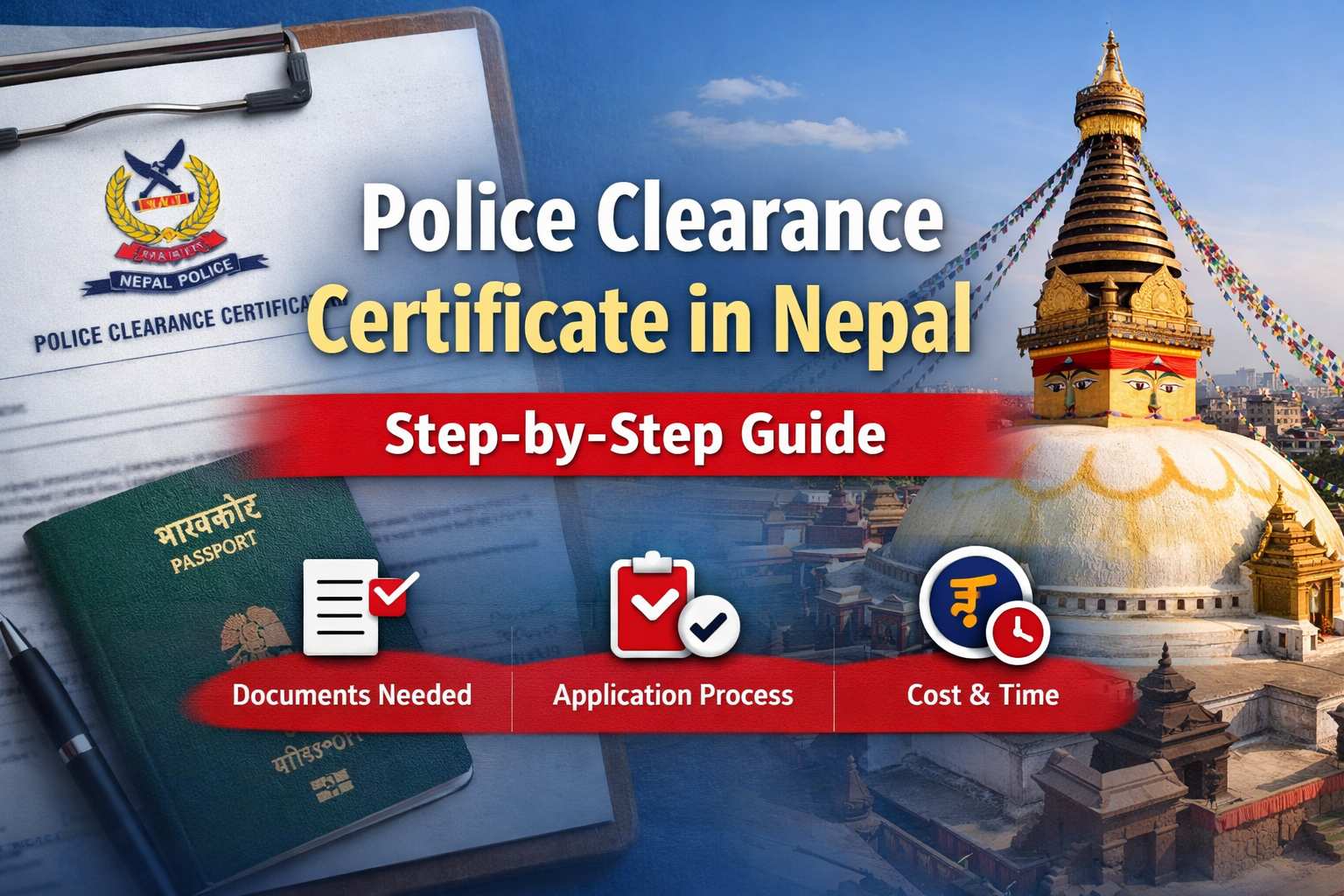
If you are planning to work, travel, or apply for a visa abroad, one of the most important documents you will need is a Police Clearance Certificate (PCC) from Nepal. For many Nepalese living in countries like the UAE, Qatar, Saudi Arabia, and beyond, handling documentation from Nepal can feel confusing and stressful. The process may seem simple on the surface, but small mistakes often lead to delays, rejections, or unnecessary costs.
This complete guide is designed to give you a clear understanding of everything you need to know about PCC in Nepal, including the application process, required documents, cost, processing time, UAE-specific requirements, and the common mistakes you should avoid. By the end of this guide, you will be able to complete your PCC smoothly and confidently.
📌 What Is a Police Clearance Certificate (PCC)?
A Police Clearance Certificate (PCC) is an official document issued by Nepal Police that confirms whether an individual has any criminal record. It is a crucial requirement for many international processes, including employment visas, immigration applications, residency permits, and even short-term visits in some countries.
For Nepalese planning to go abroad, PCC is not just another document. It plays a key role in building trust with foreign employers and authorities. Without it, your visa or job process may not move forward, which makes it essential to understand the process correctly from the beginning.
🌍 Can You Apply for PCC from Abroad?
Yes, the PCC application process in Nepal is now fully online, which means you do not need to travel back to Nepal to complete it. Whether you are in the UAE, Qatar, Kuwait, Malaysia, or any other country, you can apply for your PCC remotely with proper coordination in Nepal.
However, while the system is online, many applicants still face delays because they are not familiar with the process or do not have someone to manage verification and follow-up in Nepal. This is where proper guidance becomes important. You can get complete support through the Police Clearance Certificate service in Nepal, which helps ensure that your process is handled correctly from start to finish.
🧾 How to Apply for PCC in Nepal
Applying for PCC in Nepal is straightforward when you follow the correct steps. The process begins with preparing your documents, including your citizenship certificate, passport copy, and a recent passport-size photo. If you are applying from abroad, you will also need to provide your visa copy and the exit stamp page from your passport, as it helps verify your travel history.
Once your documents are ready, you can submit your application through the official Nepal Police online system. It is very important to enter your details accurately, as even small mistakes can cause delays during verification. After submitting your application, you will need to pay the mandatory NPR 500 fee for attestation through the Consular Department of the Ministry of Foreign Affairs. This payment can be made easily through eSewa.
After submission and payment, your application goes through a verification process. Once verified, your PCC is processed and issued. In most cases, if everything is correct, this process is completed within a few working days. For a deeper breakdown of the process, you can refer to the detailed guide on how to apply PCC in Nepal.
📄 Documents Required for PCC
Preparing the correct documents is one of the most important parts of the PCC process. You will need your citizenship certificate, passport copy, and a recent passport-size photograph. If you are applying from abroad, your valid visa copy is also required. Additionally, the exit stamp page from your passport is necessary to confirm your travel history.
Many applicants underestimate the importance of document accuracy. Even a small mismatch in name or date of birth between documents can lead to delays or rejection. To avoid such issues, it is always recommended to double-check your documents before submission. You can explore the full checklist in the guide on documents required for PCC in Nepal.
⏱ PCC Processing Time in Nepal
One of the most common concerns among applicants is how long the PCC process takes. In general, the processing time for PCC in Nepal is between two to five working days. However, this timeline depends heavily on the accuracy of your application and the verification process.
Delays usually happen when documents are incorrect, information does not match, or there is no proper follow-up. When everything is done correctly, the process is usually fast and smooth. You can learn more about this in the detailed guide on PCC processing time in Nepal.
💰 PCC Cost in Nepal
There is a common misconception that PCC is completely free. While it is true that Nepal Police does not charge a fee for issuing the certificate, there is a mandatory cost involved in the process.
Every applicant must pay NPR 500 for attestation through the Ministry of Foreign Affairs, which is a compulsory step. In addition to this, if you choose to take professional assistance, a service charge may apply. For certain countries, additional attestation fees may also be required.
For a clear and transparent breakdown of all costs, you can refer to the guide on PCC cost in Nepal.
🇦🇪 PCC for UAE (Important Requirement)
If you are applying for UAE, the PCC process includes an additional and very important step. Your PCC must be attested by the UAE Embassy in Nepal, which is handled through VFS Global located at Chhaya Center in Kathmandu.
This attestation is mandatory not only for employment visas but also in many cases for visit visas. The process can be confusing because it involves multiple steps, coordination, and proper documentation. Any mistake during this stage can delay your visa or job process.
The total cost for completing PCC for UAE requirements, including all fees, attestation, and service support, is approximately NPR 16,500. You can understand this process in detail in the guide on PCC for UAE visa Nepal.
⚠️ Common Mistakes to Avoid
Most PCC delays are not caused by the system but by small mistakes made during the application process. These include name mismatches between documents, incorrect or blurry uploads, missing documents, and lack of follow-up.
Such mistakes can easily be avoided with proper preparation and understanding. If you want to avoid these issues completely, you can go through the detailed article on common PCC mistakes in Nepal.
❌ Why PCC Gets Rejected
PCC rejection is another common concern, but in most cases, it is not permanent. Rejection usually happens due to incorrect information, incomplete documents, or verification issues. The good news is that these problems can be corrected and the application can be resubmitted.
Understanding the reasons behind rejection can help you avoid them from the beginning. You can read more in the guide on PCC rejection reasons in Nepal.
🤝 Why Choose Nepalese Sewa?
For Nepalese living abroad, managing PCC and attestation from Nepal can be challenging without proper support. Nepalese Sewa is dedicated to making this process simple, transparent, and reliable.
From document verification to complete coordination and attestation, Nepalese Sewa helps you avoid mistakes, save time, and complete your PCC without stress. Their approach is not just about processing documents but about providing the right guidance so that Nepalese can move forward confidently in their journey abroad.
You can explore all available services through the Nepalese Sewa service page or directly contact Nepalese Sewa for assistance.
🔚 Final Thought
A Police Clearance Certificate is more than just a document. It is a critical requirement that can impact your job, visa, and future abroad. While the process is straightforward, it requires accuracy, proper understanding, and timely action.
If you follow the right steps and avoid common mistakes, your PCC process can be completed quickly and without stress. The key is to start the right way and ensure everything is done correctly from the beginning.
👉 Visit the Nepalese Sewa official website and take the first step toward a smooth and hassle-free PCC process.